

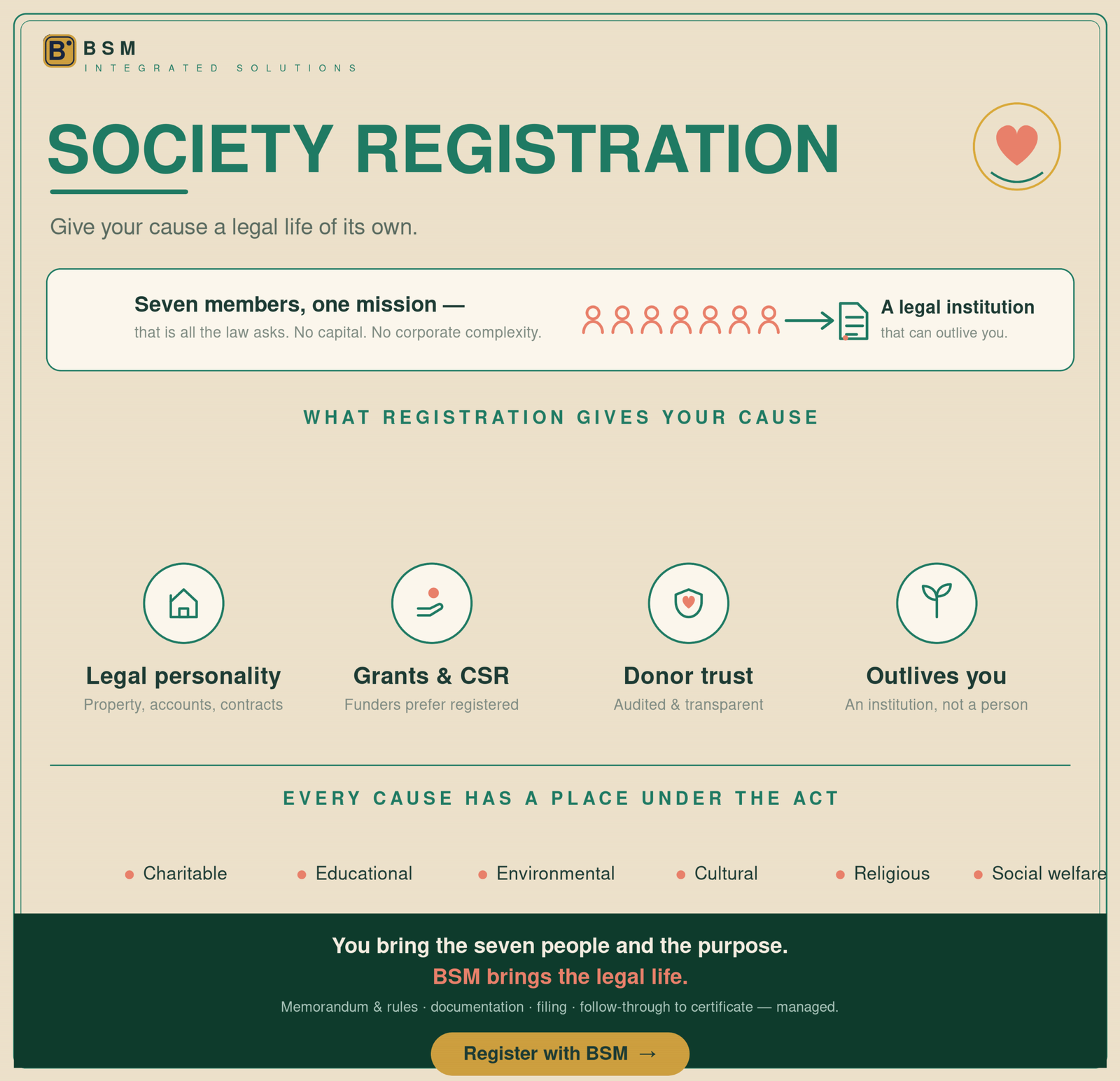
Society Registration
Give Your Cause a Legal Life of Its Own.
Behind every society is a group of people who decided a problem in their community was theirs to solve.
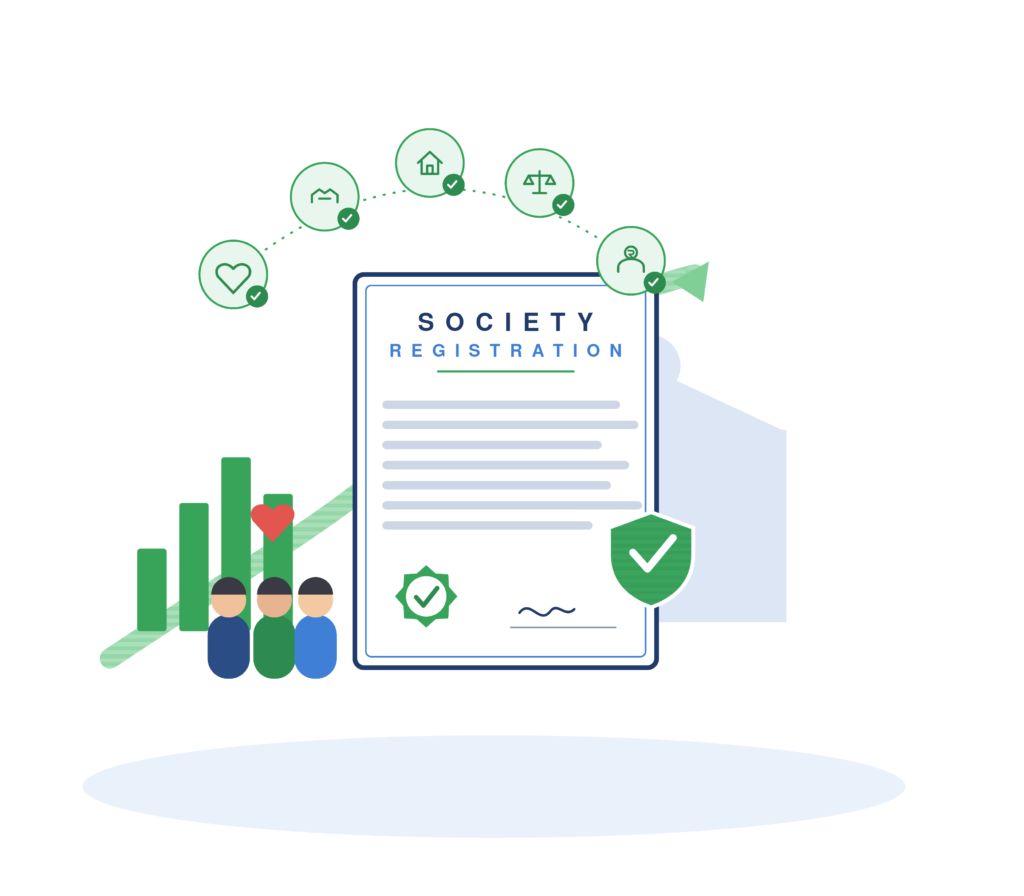
Seven Members, One Mission — That Is All the Law Asks.
The threshold is beautifully simple: a minimum of 7 members, united by a common objective — charitable, educational, scientific, literary, social, cultural, religious, environmental, or any non-profit purpose. Members must be individuals with the legal capacity to contract and a genuine willingness to pursue the society’s stated objectives, with the society established within the jurisdiction of the applicable Registrar of Societies under state-specific procedures. That’s it — no capital requirement, no commercial structure, no corporate complexity. If seven people share one mission, the law is ready to recognise it. What follows registration is the practical power your work needs: property owned in the society’s name, bank accounts in the society’s name, contracts executed in the society’s name — your cause, operating as its own legal person.
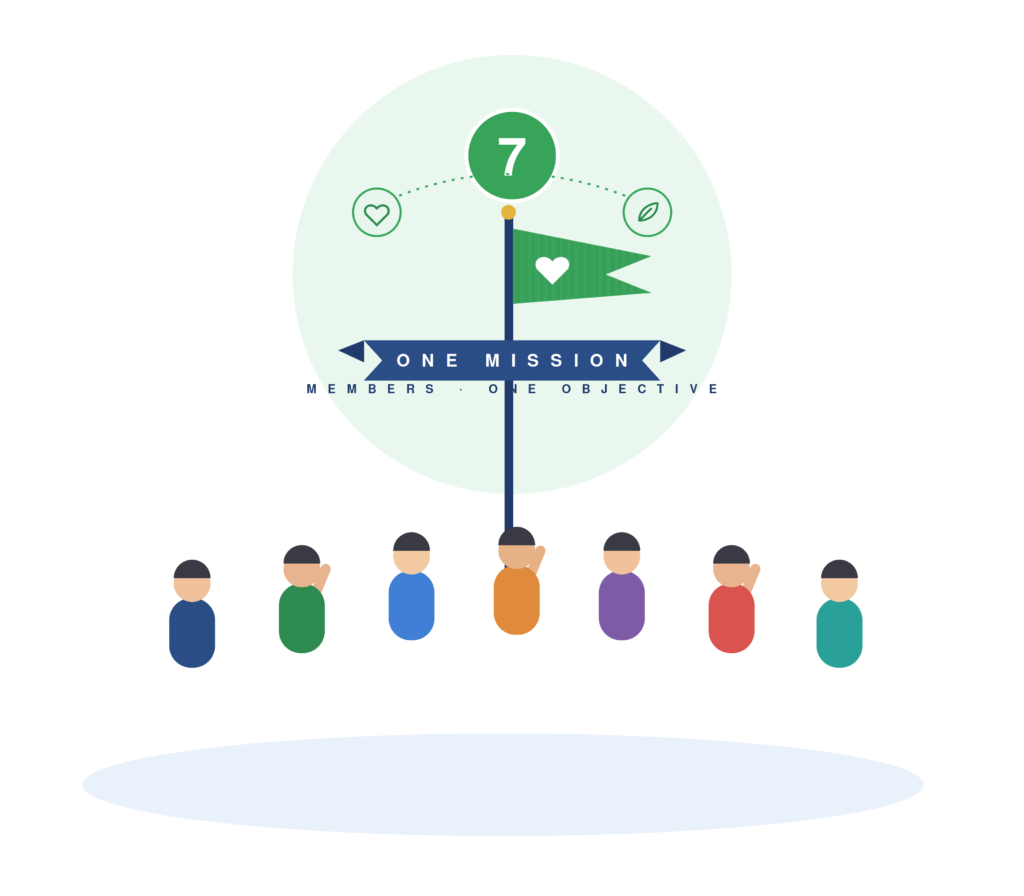

Where Funding Flows — Grants, CSR, and Donor Trust.
Good intentions don’t fund programs; credibility does. Registered societies can access government grants, CSR funding, donations, and financial assistance from public and private institutions — and government agencies actively prefer registered organizations for grant distribution, because registration assures them funds reach legitimate, compliant entities. The same structure that wins funding also protects it: separate bank accounts, audited accounts, and transparent financial reporting give every donor confidence their money went where it was promised. Governance through governing boards, general body meetings, and democratic decision-making keeps the institution accountable to its mission. Registration is how a funder’s first question — “can we trust them?” — gets answered before it is asked.
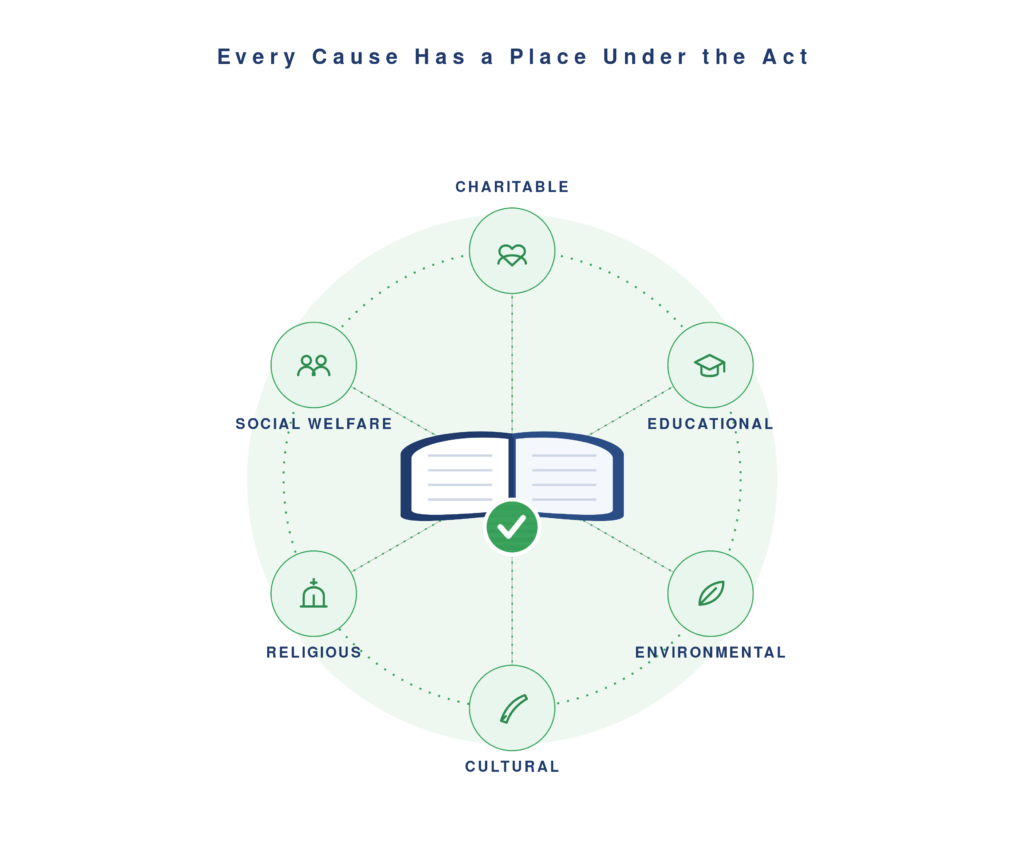
Every Cause Has a Place Under the Act.
▸ Charitable Organizations — societies providing relief to the poor, sick, disabled, or distressed — healthcare providers, food distribution services, and welfare programs.
▸ Educational Organizations — schools, colleges, research institutes, and learning centers bringing education and skill development to communities.
▸ Environmental Societies — organizations devoted to environmental protection, conservation, sustainability, and advocacy.
▸ Cultural & Literary Organizations — cultural associations, literary clubs, and heritage preservation organizations keeping arts and culture alive.
▸ Religious Organizations — religious congregations, temples, mosques, churches, and spiritual organizations serving their communities of faith.
▸ Social Welfare Organizations — welfare societies, social clubs, and community organizations serving social causes and community development.
Whatever brought your seven members together — the Act has a place for it, and the Registrar has a certificate waiting.
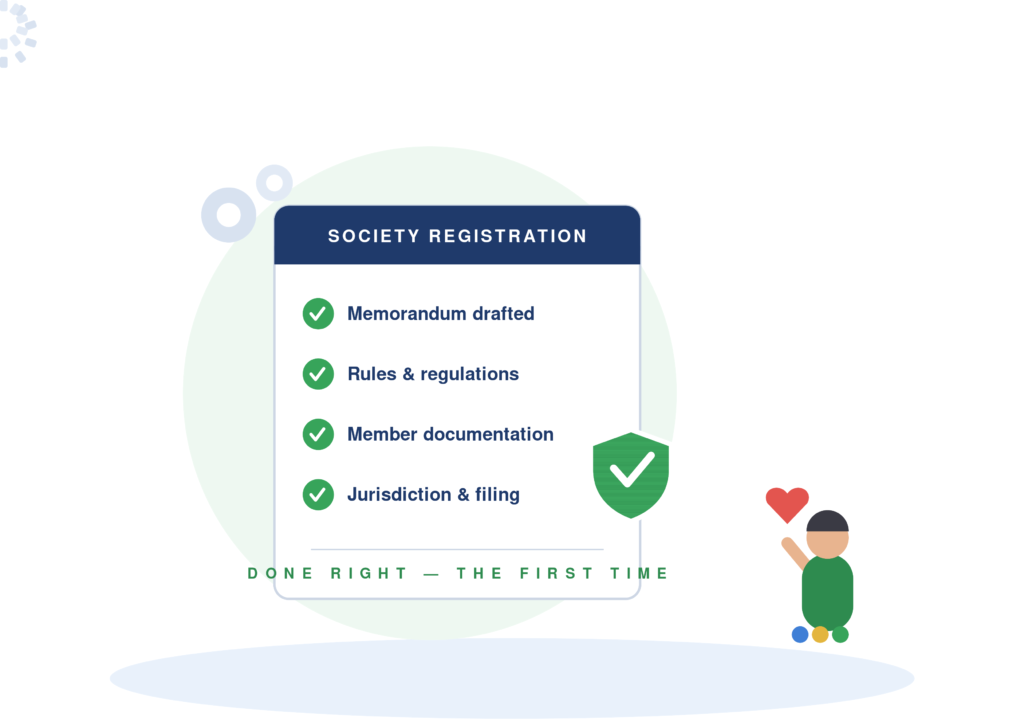
You Started This to Serve People — Not to Fight Procedures.
Memorandum drafting, rules and regulations, member documentation, jurisdiction requirements, state-specific procedures — the path to registration is exactly the kind of bureaucracy mission-driven people never signed up for. And errors cost more here than anywhere: a defective memorandum or misfiled application can stall your registration for months — months your community waits. BSM manages your Society Registration end to end: objectives drafted to satisfy the Registrar, documentation prepared correctly the first time, filing and follow-through until the certificate is in your hands — with ongoing compliance support for the filings, renewals, and records that keep your society in good standing year after year. You bring the seven people and the purpose. BSM brings the legal life — so your energy goes where it always belonged: the mission.
Talk to BSM Today
Zero obligation · Compliance experts · Same-day response